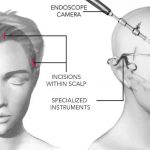
Endoscopic facelift is a new plastic surgery procedure used to rejuvenate the upper and middle part of the face (forehead, eyebrows, cheeks). Unlike traditional facelifts that require large incisions, in this technique, the surgeon uses an endoscopic instrument that includes a small camera and special surgical tools. These tools are inserted under the skin through very small incisions, allowing for precise observation of the underlying structures and their correction with high precision.
- Creating very small and less visible incisions Significant reduction in swelling and bruising Faster recovery than classic methods Maintaining the natural shape of the face without creating artificial stretching Long-lasting results Possibility of combining with other cosmetic surgeries such as blepharoplasty or neck lift
This procedure is usually suitable for people who have mild to moderate sagging in the forehead, eyebrow or cheek areas and are looking for a natural change without the need for major surgery. Ages 35 to 55 usually respond best to this technique.
- General or local anesthesia is used. Several small incisions are made in the hairline or behind the ear. An endoscopic camera and special instruments are inserted and the muscles, tissues, and skin are gently lifted. The lifted areas are fixed in their new positions and the incisions are sutured.
- Mild swelling and bruising that will subside within one to two weeks. Return to daily activities within 7 to 10 days. Final results are fully visible after 3 to 6 months. It is recommended to avoid direct pressure on the surgical sites and heavy activities during the recovery period.
- Use cold compresses to reduce swelling Follow your doctor’s medication instructions Sleep on your back with your head elevated Avoid direct sunlight on the surgical area See your doctor for regular checkups